Thursday, August 15, 2024

A Widow Gives; Luke 21:1-4

Here is another story with suggested activities centered around four words from the story. 
This can be used as a mini-preschool, with one word per day, or with a Bible club for children. (Illustration by Richard Gunther, Lamb Songs.)

Watch/see

·       Play “I spy with my little eye” also known as “I see something” or “20 Questions”(Ik zie ik zie wat jij niet ziet). One person sees something. Everyone else tries to guess what they see. The person who “sees” something can only answer “yes” or “no”.

·       Leader leads the group in “seeing” by asking questions like:

  • What do you see that is ___________ (a certain color, such as green; red; etc.).
  • What do you see that is  _________ (a certain shape, such as round, square).
  • What do you see that is __________ (living. Answers might include a tree; a bug).
  • Can be made into a team game. The two teams take turns answering the questions & naming what they see. The team that “sees” the most (has the most answers) wins.

·       Scavenger hunt. (Being aware of your environment; watching) See Davar Start Game: Spot the Shapes.

  • Let’s find something that is a circle . . .
  • Let’s go find something that is . . . heavy
  • Can you find something that is . . . smooth

·       Any game from Davar Start Games: Visual Skills.

·       Play Red Light/Green Light or similar game.  Players have to watch to see if someone is moving. The game is also about self-control, because players practice controlling their own bodies.
One person is the caller or “traffic cop”. They stand at the end goal. Everyone else stands behind the starting line. The goal is to get past the caller.
The caller stands with their back to the rest of the group. When the caller says “Green light,” everyone can run towards the goal.
When the caller says, “Red light,” everyone freezes. The caller immediately turns around. If they see anyone moving, that person has to go back to the start line.
Children do not need to be familiar with traffic lights to play this game, as long as the words for moving & for freezing in place are explained to them.

Give

·       Make something & give it to someone else (put a plant in a pot; bake something; make a card; make flowers . . .). Doesn’t have to be physical things. Could also be helping to pick up for other people. (Davar Letter Games: E3 and E5)

·       Discussion:  what can we give? See what kids come up with. Time, possessions, praise (songs, to God), being nice, pat on the back . . ..
Giving, not keeping for yourself.
Also discuss: How do you give? How did the widow give? What was good about how she gave?

·       Give compliments. Discuss what a compliment is. Model giving compliments. Then have the group practice this. Go around the circle and take turns giving the person next to you a compliment. Or turn to the person next to you and exchange compliments. Model this.

·       Find a Coloring page of woman giving the coins. Everyone colors the picture, then gives it to someone. Reinforces that the children are doing the same thing that the woman in the story did. (Many fun coloring sheets available on Lamb Songs, www.lambsongs.co.nz.)

·       Affirmation. You can give a handshake or a pat on the back. Might do this as a group with each other.

Coins

·       Davar FUNdament Thick, Thin, Thickest: 6.7 

·       Learn the names of coins in local currency. Show kids different local coins & teach them the names for them.
Or find worksheet online which teaches local currency.
OR Practice counting with the coins.
Might demonstrate that 5 of this coin = 1 of that coin, etc.

·       Stacking coins—see how high we can get them without tipping them over. (Could be done in teams.) Shows that the more coins you have, the better material standard of living you have.

·       Playing store. Set up small store with, among other things, healthy treats (apples, etc.) which the children can ‘buy’. Each child has same number of “coins.”
Have some items cost 2 coins. That’s what the woman gave—she gave all that she had to live on.
With the coins you can get something—food, what you need to live.
(For an older group, you might make a sample budget.)

Extra/all

·       Dramatize the story (“Jesus”, “widow”, 1 or 2 “rich people”; everyone else “disciples”). First give a visual of all vs extra. Give the person playing the widow 2 “coins” (blocks, nuts, buttons, play coins); give the rich person a lot more coins. Have the group count the coins that each person is given.

Then have the group watch and count as each person gives into the treasury (a box or something). The rich person gives a lot, but not all of their coins.
Which person gave all?
Which person just gave extra? (if give 50% of what you have)
Compare & contrast the idea of all and extra. Everybody gave—but who gave all and who gave extra (had extra for themselves)? How much does the rich person have left? (Count as a group.)

·       Discuss a team game the group is familiar with that only has a certain number on the team (football, baseball, cricket). If we play this game, can everyone play? Can all the people in the group play this game? Or do we need some to sit out as extras?
Which games can everyone (all) play? (example—Red Light, Green Light).

·       Dress up. Have a set of oversized clothes so that the children can easily put these on over their own clothing; make sure to have one extra of something that there should only be two of. Have a volunteer put on all the clothes. Maybe have 3 shoes instead of 2. That would be an extra. You can’t put on 3 shoes (if you put on all the shoes, you’d have to put them on your hands).

·       Play a relay game with oversized clothes.  The teams run to one end of the playing field where the runner has to put on all the clothing (maybe just mittens & a hat? A large t-shirt & a scarf?), then take it all off & run back.

 We look forward to hearing feedback when you use these four words with this story!

Suggestions by Crista Smidt & Mary VanRheenen

Thursday, July 25, 2024

Fun at Summer School!

Summer school doesn't necessarily sound fun. But the month-long summer school in this Romany village in Romania will be. 

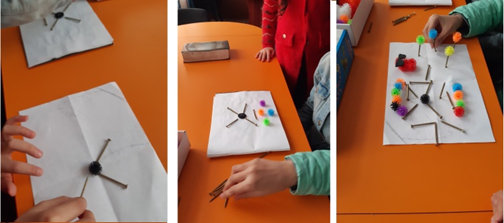
Last year children who did not normally go to school enjoyed making, listening, and learning through games like this one (Darts Without Darts, Davar Math Game 19). These children also learned that they could successfully learn. For example, by the end of last year's summer school, the younger children succeeded in writing their first names; the oldest children succeeded in writing both their first and last names. (More photos and details on the site of Stichting Aria, the Dutch non-profit which organizes these summer schools.)

Pray with us for this year's summer school. It will begin this coming Monday, July 29. Pray for encouraging results, unity within the team, God-given strength and energy for the leaders. And praise God for each child who comes and learns!

P.S. Leave a comment if you would like to see the outline for last year's summer school. It might stimulate you or someone you know to do the same.

Tuesday, July 2, 2024

4 WORDS: FLEXIBLE BIBLE LESSONS/EDUCATIONAL LESSONS

People who work with Romany children need to be flexible. Sometimes 30 children come; sometimes only 3.
Sometimes most of them are preschool-age; sometimes half of them are preteens. These suggestions are also flexible.

Four concrete words have been chosen from each Bible story. These words aid in remembering the story.

There are suggested activities to go with each of the 4 words. These Davar: Bridging to Literacy activities also practice school-related skills and help people of any age be more ready to read and write.

Each leader chooses how to tell the Bible story. Perhaps existing Bible lessons are used. Perhaps the leader has to make up their own Bible lessons. Perhaps the leader simply tells the Bible story. Every leader will change and choose from these suggestions for their own club.
Here is one example. Feel free to contact us for more information or more suggestions!

Esau and Jacob are born – Genesis 25:19-28

Nothing  - Rebecca had no baby, nothing happened (prayer)

Twins  -  Rebecca had twins, two babies (answer to prayer)

Different  - the boys were totally different, with different futures.

Tent - Jacob stayed home, in the tents, and helped his mother.

Suggested activities:


Nothing

FUNdament 11 Missing/Gone. Give everyone a folded paper, some have a little sweet in it, others have nothing.


Nothing, a bit, enough, much, too much. Explain the meaning of these words. Have each word written on a separate piece of paper. Put these at one end of the room. Also have smaller pieces of paper for everyone in the group with one of these words written on it. Hand the papers out, so that each person has one.
At a certain signal, everyone runs to the word on the floor that matches the word in their own piece of paper.


Nothing, something. Use words for amounts in both school language and home language. Everyone can increase their vocabulary.

Cook something together. Together, measure the right amount of ingredients. Or together feel/stir/taste and see if there is enough or too much.

Twins

FUNdament 9 Two - activities

Nice name? Parents choose names for their children. Discuss which names the group like. (This gives insight into the way the group thinks, and what they find important.)

Have each person make a paper hat with one of their favorite names written on it. Talk about a letter in that name.

Letter Game B8, variation 4. Everyone with an “A” in their name goes . . . (over by the window or stands by the red chair or . . . ). Everyone with a “J” in their name goes . . . .


Different and the same are words used in education, We need know these two ideas in order to do well in school. We play games to teach or practice both words in the school language and the home language.

Start Game B3 Mosaic, B5 Statues.  Are all the statues (or mosaics) the same?

FUNdament 10 The Same.  Make it fun, choose one person to do everything DIFFERENT while the others do the same

Draw differences. Everyone draws their own human figure. Then they draw another one which if very different than the first drawing.

Do a “see the differences” worksheet (Example with 2 houses, available via link).

Tent

Make a tent out of cloths or blankets. Eat a snack in the tent.

Take turns acting out some task that is done in the house (cooking, washing, etc.) The rest of the group has to guess what is being acted out. 

Connect the dots to draw a tent.


Marleen Schonthaler and Mary van Rheenen


Friday, May 24, 2024

Games are an important part of learning. Olesea Ciochina plans at least four games or activities for each of the mother/child clubs she leads. 

But something extra fun happened recently. One of the children came up with a game . . . which they all played enthusiastically. The crayons and colored pencils were lined up in the middle of the work table. Then each child chose three . . . while blindfolded. The others watched attentively to see which three would be chosen. They each used their three random colors to "draw something beautiful." 

(Skills practiced:  creativity, cooperation, waiting ones turn, fine motor skills (drawing) also used in writing.)

Other activities included musical chairs (a favorite)


making and decorating the first initial of their names


and making a family tree. This boy put God in the middle of his family! 

Note that some of the children are using the Cyrillic alphabet. Russian as well as Romanian is widely used in Moldova. And just to make the linguistic situation more fun, at home the children speak their own Usari Romani. Olesea is extremely grateful for the mothers who translate into Usari so the youngest children will understand the Bible lesson AND the instructions for the games & activities.

The Bible story focused on Jacob marrying Leah and Rachel. Family and the names of Jacob's (many) children figured into the story. It took awhile for Jacob to put God in the middle of his family. May these children . . . and their parents . . . learn this lesson early on.


Friday, April 26, 2024

Learning by Doing: Mug Cake Lesson

 What can you learn by making a mug cake together? LITERACY, of course. We read the recipe--or we see someone reading the recipe. We see literacy in action. We see the value of being able to read. But we also practice:


HYGIENE:  we all wash our hands before beginning. 


MATH:  we measure carefully. We count the number of spoonfuls of oil (or cocoa or . . .) need to go into the cake.


WORKING TOGETHER: we all take turns stirring the cake batter and decorating the cake.


FINE MOTOR SKILLS:  necessary for writing. (See how carefully we decorate with these tiny stars!)


PATIENCE:  we have to wait while the cake bakes.


TAKING TURNS/SHARING:  we all get a taste of the cake we helped make.


We also have the SATISFACTION OF A JOB WELL DONE!


(Davar: Bridging to Literacy Letter Game E3. Click on link to see versions in English, Romanian, or Dutch.)  

A big thank-you to the children, moms, and leaders of the Mother-Child Club, Bethlehem Baptist Church, Moldova.

Friday, February 16, 2024

 A new mother-and-child club started meeting this month in Bethlehem Baptist Church, Moldova. Pastor's wife Olesea Ciochina plans the lessons and activities.

A mom translates the Bible story into the children's first language (Usari Romani). 

The moms and children enjoy doing the games and activities together. 

The lesson this past week told how Adam and Eva chose not to listen to God and ended up having all kinds of really bad consequences (most a lot worse than needing to wear clothes!).  


The moms helped the children cut out and glue clothes on Adam and Eva. 

Children took turns leading the singing.

Together they played games like Davar Letter Game B5: Letters as Mosaic. 

In fact, they all had such a good time that most stayed for three hours!

All were blessed by learning and playing together.

Note:  photos with children's faces have been blurred to protect their privacy.


Thursday, January 18, 2024

Portrait of a Sinti Bible Club Leader: Otta Laubing, Germany


My husband Keith Holmes and I have known  Otta Laubing and her husband Kennedy for at least 20 years. Kennedy was one of the voice talents in the first recording Keith ever did, Jesus film, Sinti Romanes 2001.

Otta has been working with Christian education even longer. She began by helping with Sunday school in the church she and her husband attended. (Photo:  Keith delivering Bible story coloring books in Sinti Romanes to Otta and Kennedy, 2008.)

 “My children were still little. I worked with the Sunday school,” she told me. “Then it became my calling.”

Indeed, Otta has since helped with camps, taught Romanes (the word Sinti use for their own language) to Sinti children in the German school system, helped create and record a bilingual Children’s Bible story book (Kalderash Romani and Sinti Romanes), and spearheaded the translation of Sunday school material into Kalderash and Romanes. 


Additionally, as part of her drive for Christian education, she has been worked with the translation team which successfully published first the New Testament (2010) and then the entire Bible in Romanes. 

Otta then organized online and in-person Bible reading groups of adults as well as children. This stimulated reading in their own language as well as Bible study. As part of this work, she recently completed a daily devotional book in Romanes.  (Photo:  dedication of entire Bible, 2021. Work done in cooperation with Romanes Arbeit Marburg. https://romanes-arbeit-marburg.de/)

But all that came later. Her calling started simply, in the local Sunday school. First she worked alongside experienced Sunday school teachers. Soon she was put in charge of her own Sunday school group. The Sunday school leaders would give her and the others the theme or topic to teach.

 “We had to work out what we would actually do for ourselves,” she explained. “I had to develop my own program.”

At the time, she and Kennedy attended a German-speaking church with members from many different backgrounds, including a large number of Sinti. Kennedy himself felt called to become a pastor. At first his own pastor did not encourage him because of Kennedy’s low educational level. However, the call persisted, so Kennedy finally talked directly with the head of the Bible School. He successfully completed the course, surviving a bout with cancer while doing it. He and Otta have since started at least three churches on their own. Quelles des Lebens (Well of Life), the church which Kennedy now pastors, is also truly international. Consequently, Otta has experience teaching Roma, Sinti, German, and immigrant children.

 “I do this with much pleasure,” Otta said.


She also does it with much insight and experience. I have seen her lead a group of Roma children in the Republic of Moldova. She kept them occupied in one corner of the church while a worship service was going on in the main part of the same room. Otta started with a Bible storybook and continued inventing one activity after another to keep them occupied.

 They communicated with the basic Romani words which can be understood in both their native Usari Romani and her Sinti Romanes. But most of all, Otta communicated through her good humor, patience, and obvious love for the children and the Word.

 I asked Otta if she had any tips for other teachers working with Roma and Sinti children. Yes. Her advice was, “Do not pressure the children. Don’t be too strict. Then the parents also feel as if you are correcting them. Of course the children must follow the rules you set out, but don’t be too severe.”

Otta added, “And don’t touch the children.” Keep your hands off, especially when it comes to correcting a child.

She also highly recommends the children’s coloring Bible by Margitta Paul.

“It is very good material! It is so Biblical!”

Otta is so enthusiastic that she and others in her church have translated the material into (Polish) Kalderash and also Sinti Romanes. The Kid’s Bible Colouring Book had already been published in many different languages. Otta had special permission from the author to translate the material into these Romani languages. Marlute van Dam, a seasoned Wycliffe/SIL Bible translator, assisted.

The lessons begin with Creation, move through the Bible, and end with the Acts of the Apostles. Each lesson includes a Bible story, two or three discussion questions, and a free coloring sheet.

Each child in their Sunday school gets their own loose-leafed notebook. With each Bible lesson, the children get a print-out of the story (in their own language) to add to their notebook. They also get a picture which they color themselves. In the end, each child will have their own colorful Children’s Bible Storybook.

Otta also adds a Davar: Bridging to Literacy game to each lesson.

“Davar games calm the children,” she said.

 She chooses a game that matches the lesson. For instance, the story of David and Goliath was paired with one of the games using stones.

Otta also used Davar activities in the Romanes language lessons she taught in the German school system. She would get a classroom full of children of all ages and abilities at the end of the school day. A “sit-in-your-chair-and-listen-to-the-teacher” lesson would have been pointless.  She used Davar activities to actively engage the children. (Photo courtesy of RAM website:  Otta and Kennedy with the primer and other resources she uses in school.)

 This is what Otta does in Sunday school as well. 

“By Noah’s ark we might build a boat with chairs,” she said. 

Otta now trains others to lead Sunday school, just as she herself was trained. She works alongside the new teachers for a while and gives them suggestions. Soon the new teachers are coming up with their own ideas. 

“People who work with children are usually creative,” Otta observed. “They can think of things like this for themselves.” 

Otta has offered to write down which Davar game she uses with which Sunday school lesson. Just in case teachers are not feeling creative on this or that day.

In the meantime, she continues to work on Christian Education for all ages. The entire New Testament has already been recorded in Romanes. Now she is working towards an audio recording of the Old Testament as well.

Truly, spreading the Word of God first in her own language and then to others continues to be her calling.