Friday, June 25, 2021

Dragă cititorule,

Probabil citești acest articol pentru că acesta este modul în care primești informația, prin cuvintele scrise. Sau s-ar putea să fi apăsat din greșeală pe acest link. Oricare ar fi situația, oare te-ai întrebat vreodată care este modul tău de gândire? Sau prin ce modalitate îți iei informațiile? S-ar putea să fii ca mine și să preferi să citești. Sau poate înveți prin auzire.

Aș vrea să îți spun o poveste despre două orașe învecinate, separate printr-un râu. Unul dintre orașe a fost fondat prin documente scrise. O lume a cuvintelor scrise pe hârtie. Acesta este orașul în care eu locuiesc. Îl văd ca pe o lume ordonată și structurată. Construim comunitatea de la tastatură sau cu pixul pe hârtie. După un singur principiu: “Ce e scris, rămâne”. Mai există un oraș care are la bază vorba. O lume care mie îmi pare haotică și dezordonată. Această comunitate se bazează pe experiența de viață și pe cuvântul rostit. După principiul: “Amintește-ți că s-a spus

Eu sunt un cetățean al cuvântului scris. Adesea m-am gândit că noi avem cel mai bun mod de a învăța. Dar lucrurile nu sunt atât de simple. Ori de câte ori sunt pe malul râului mă fascinează să-i aud pe vecinii mei spunând povești, cântând cântece sau relatând fapte din istoria lor. Ei fac acest lucru fără să trebuiască să citească informațiile de pe o hârtie. Mi se pare uimitor. Sau, trebuie să recunosc, sunt mai mult gelos decât uimit. Și mie mi-ar plăcea să îmi pot aminti toate cuvintele spuse de un anumit povestitor. Sau să îmi amintesc versurile sau dansul unui anumit cântec doar auzindu-l și văzându-l.

Înaintașii noștri, cei care au pus temeliile orașului, ne-au avertizat despre pericolul care ne paște dacă interacționăm cu vecinii noștri. Dar eu m-am întâlnit în secret cu unul dintre vecini. Învățăm reciproc despre culturile noastre diferite. Planul meu este ca, în curând, să pot vizita orașul lui. Aș vrea să experimentez cum e viața în lumea lui. Dacă îmi reușește planul, vă voi scrie despre lucrurile pe care le-am învățat.

Până la următoarea scrisoare,

Songz


Thursday, June 24, 2021

A Tale of Two Towns


Dear reader,

You are probably reading this because you get your information through the written word. Or you might happen to have clicked on the wrong link. Either way, I wonder if you have ever thought about  how you think? Or the way you take in information? You might be like me & prefer to read. Or you learn by listening.

I’d like to tell you a story about two neighbouring towns separated by a river. There is one town which was founded on a written document. A world of the written word. This is where I live. We see it as a world of order & structure. We build our community with our keyboards or pen & paper. Under one law: The Written Word Lasts Longer. There is another town founded on speech. A world that seems to me to be chaotic & messy. This community is built by living life and on the spoken word. Under one law: Remember It Was Said.

I am a citizen of the written word. I have often thought we have the right way of learning. But, it is not that simple. Whenever I’m by the river, I am often amazed at how easily the people from the neighbouring town remember the speeches, songs & actions of their heroes. They do this without having to read information from a page. It seems strange to me. I’ll admit, I’m more jealous than amazed. I, too, would love to be able to recall every word delivered by a speaker. Or to be able to remember the lyrics and dance moves of a song just by hearing and seeing it.

Our founding fathers warned us against the dangers of mixing with the other town folk. But, I have been meeting in secret with a person from the neighbouring town. We are learning about our different cultures. I plan to visit his town soon. I wish to experience life in his world. If our plan is successful, I’ll write back on what I’ve learned.

Until we read again,

Songz

Oral Cultures . . . tips for travelers from the world of print

Songezo Nkolombe
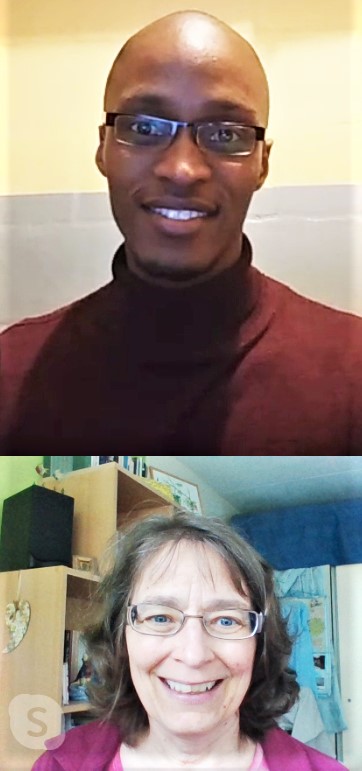
and Mary online
We're about to start a new series of posts on oral cultures titled A Tale of Two Towns by Student.Go intern Songezo Nkolombe.

Songezo Nkolombe just completed his first year of seminary (Baylor) online, due to Covid travel restrictions. He lives in Cape Town, South Africa, and serves as children's minister in a Baptist church there. It was a natural fit for him to work with Romany education projects. His first blog post on oral learners and oral culture will appear on the Romany Education Network this week. He's read a lot, he's listened a lot, and now he's turning that into Yearn to Learn: A Tale of Two Towns. 

Songezo brings a wealth of experience to the internship. He has served for a number of years as children's minister in his home church in Capetown, South Africa. He lives in a multi-ethnic city. And although he was definitely raised in a print culture, many extended family members live in an oral culture. 

Songezo has sat in and contributed to on online meetings for Romany education projects in Romania and Moldova. He has read and discussed studies in oral cultures. And now he's started to translate that into story form. What an oral culture way to help print people better understand oral cultures!


Tuesday, March 9, 2021

Multilingual Students; Multilingual Teacher

What language do your students speak at home? And what language do you use for instruction?

Our friend Zoltan Barabas teaches a Bible club in Transylvania. Instruction in school is in Romanian.

Some households in this Rroma village speak mainly Romani, some Romanian, some Hungarian. All of them use a mixture. 

This situation is very familiar to Zoltan. Though he was born in Romania, his first language is Hungarian. He teaches most of the Bible club in Romanian, but the "central truth" and the memory verse are always given in Romani. (See ashunledevles.eu.org for examples of this dialect in three different orthographies, including Hungarian.) 

This past week, the children played a Davar Start Game called Count At Home. First they played the game in Romanian. When finished they had counting together, they repeated the game with numbers in Romani. 

Zoltan explained, "Some kids are not so fluent in Romani; some are more fluent in Romanian. All instruction at school is in Romanian. That's the reason to explain it first in Romanian. Then we did it in Romani to put it clearly in their head in Romani. Especially for kids who are fluent in Romani. They can think about math and numbers in both languages."

Zoltan added that this reinforces the value of both languages. "I use myself as an example to reinforce that the mother tongue is important. Hungarian is my first language. But I do most of the lesson in Romanian. Sometimes I talk with adults (who happen to be in the house where the children's club meets) in Hungarian because they are more fluent in that language. I reinforce that it is okay to use Romanian and that the mother tongue (Romani) is important." 

"Personal example always best teacher," he concluded.

How would you handle this situation? 

Friday, February 21, 2020

Language and Learning

Today, on International Mother Language Day, I warmly recommend to you a message from the SIL Executive Director, Michel Kenmogne, reflecting on the power and role of local languages.
The words and pictures in the short video below show glimpses of a few places in our world where people have decided to give their children a strong foundation in life by allowing them to receive their first years of schooling in their own language, before continuing to learn in a regional or national language.

It is my hope that many Roma children in Europe and elsewhere, will be able reap the benefits of this kind of opportunity for them also. I am thankful for the hard work of others elsewhere that allow there to be good examples and encouragements in my continued networking and advocating for good quality and relevant education in Roma communities.

Sincerely,
Marianne Fast
Literacy Consultant SIL International


Click to watch the video.

Wednesday, March 6, 2019

Teaching . . . and Learning to Teach . . . at Home

How many kids live in your house? Enough to start a club?

A couple we know have that many in house, though they only have two children themselves. We'll call them Silvia and Eduard. Before Eduard married, he helped in his own Romany village with the first field trial of the Parent-Child Club. Now that he is a parent, he and his wife have started doing Parent-Child Club activities . . . in their own house.

This house has three rooms. A different family lives in each room. All together, there are 9 children roaming around, ages 13 to infant (Eduard & Silvia have two, under the age of 2.) So Eduard and Silvia were very open to trying out Parent-Child Club activities in their own home. Eduard's sister Aliona helps.

And in between the Friday afternoon activities, the children go on playing the games themselves!
Interested in learning more? Check out the Parent-Child Club activities in English or Romanian. (Dutch language version available upon request.)