Thursday, June 24, 2021

Oral Cultures . . . tips for travelers from the world of print

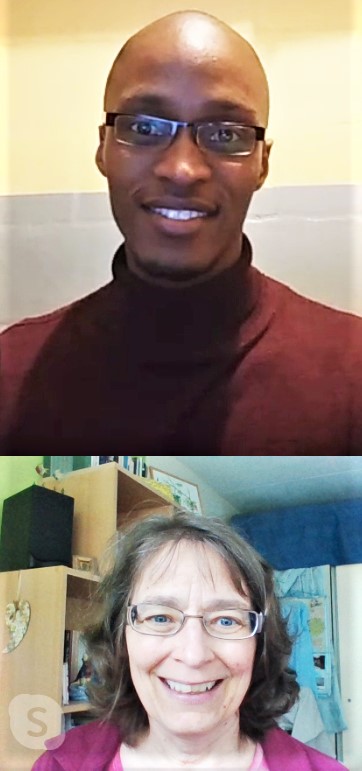
Songezo Nkolombe
and Mary online
We're about to start a new series of posts on oral cultures titled A Tale of Two Towns by Student.Go intern Songezo Nkolombe.

Songezo Nkolombe just completed his first year of seminary (Baylor) online, due to Covid travel restrictions. He lives in Cape Town, South Africa, and serves as children's minister in a Baptist church there. It was a natural fit for him to work with Romany education projects. His first blog post on oral learners and oral culture will appear on the Romany Education Network this week. He's read a lot, he's listened a lot, and now he's turning that into Yearn to Learn: A Tale of Two Towns. 

Songezo brings a wealth of experience to the internship. He has served for a number of years as children's minister in his home church in Capetown, South Africa. He lives in a multi-ethnic city. And although he was definitely raised in a print culture, many extended family members live in an oral culture. 

Songezo has sat in and contributed to on online meetings for Romany education projects in Romania and Moldova. He has read and discussed studies in oral cultures. And now he's started to translate that into story form. What an oral culture way to help print people better understand oral cultures!


Tuesday, March 9, 2021

Multilingual Students; Multilingual Teacher

What language do your students speak at home? And what language do you use for instruction?

Our friend Zoltan Barabas teaches a Bible club in Transylvania. Instruction in school is in Romanian.

Some households in this Rroma village speak mainly Romani, some Romanian, some Hungarian. All of them use a mixture. 

This situation is very familiar to Zoltan. Though he was born in Romania, his first language is Hungarian. He teaches most of the Bible club in Romanian, but the "central truth" and the memory verse are always given in Romani. (See ashunledevles.eu.org for examples of this dialect in three different orthographies, including Hungarian.) 

This past week, the children played a Davar Start Game called Count At Home. First they played the game in Romanian. When finished they had counting together, they repeated the game with numbers in Romani. 

Zoltan explained, "Some kids are not so fluent in Romani; some are more fluent in Romanian. All instruction at school is in Romanian. That's the reason to explain it first in Romanian. Then we did it in Romani to put it clearly in their head in Romani. Especially for kids who are fluent in Romani. They can think about math and numbers in both languages."

Zoltan added that this reinforces the value of both languages. "I use myself as an example to reinforce that the mother tongue is important. Hungarian is my first language. But I do most of the lesson in Romanian. Sometimes I talk with adults (who happen to be in the house where the children's club meets) in Hungarian because they are more fluent in that language. I reinforce that it is okay to use Romanian and that the mother tongue (Romani) is important." 

"Personal example always best teacher," he concluded.

How would you handle this situation? 
Friday, February 21, 2020

Language and Learning

Today, on International Mother Language Day, I warmly recommend to you a message from the SIL Executive Director, Michel Kenmogne, reflecting on the power and role of local languages.
The words and pictures in the short video below show glimpses of a few places in our world where people have decided to give their children a strong foundation in life by allowing them to receive their first years of schooling in their own language, before continuing to learn in a regional or national language.

It is my hope that many Roma children in Europe and elsewhere, will be able reap the benefits of this kind of opportunity for them also. I am thankful for the hard work of others elsewhere that allow there to be good examples and encouragements in my continued networking and advocating for good quality and relevant education in Roma communities.

Sincerely,
Marianne Fast
Literacy Consultant SIL International


Click to watch the video.

Wednesday, March 6, 2019

Teaching . . . and Learning to Teach . . . at Home

How many kids live in your house? Enough to start a club?

A couple we know have that many in house, though they only have two children themselves. We'll call them Silvia and Eduard. Before Eduard married, he helped in his own Romany village with the first field trial of the Parent-Child Club. Now that he is a parent, he and his wife have started doing Parent-Child Club activities . . . in their own house.

This house has three rooms. A different family lives in each room. All together, there are 9 children roaming around, ages 13 to infant (Eduard & Silvia have two, under the age of 2.) So Eduard and Silvia were very open to trying out Parent-Child Club activities in their own home. Eduard's sister Aliona helps.

And in between the Friday afternoon activities, the children go on playing the games themselves!
Interested in learning more? Check out the Parent-Child Club activities in English or Romanian. (Dutch language version available upon request.)

Sunday, January 6, 2019

Toys library


Another project welcomed in Rroma communities is „toys library”, which offer a warm environment for children to explore new toys, new games and new ways of spending time.
These „libraries”  offer a warm environment for children to explore new toys, new games and new ways of spending time.
Through this project children can experience different roles through play. They can also socialize in a positive environment with children of the same age or different age. The children and their families can observe how to keep toys tidy and organized at home. Part of that is learning rules, like each time when you finished playing with something, it needs to be  put back, properly. Children also learn how to handle things respectfully:  toys are never thrown;  we can harm others by doing so (and destroy the toy!).
By playing, children can learn all sorts of different problem-solving strategies. Play facilitates  language development. Play leads to developed social skills. The toy librarian can increase the complexity of playing. The librarian can help children to move beyond simple and repetitive ways of playing, through his own intervention and example of using the toys.
The program can be implemented in Rroma communities following some concrete rules:
-        the families have to book their time to play inside the library, before they visit it.
-        only those families which proved, while their children were playing there, that they can handle the toys responsibly may take them home for a limited time. This is similar to checking out a book at a regular library.
-        the number of families that can visit the library at the same time should be limited, perhaps to no more than 4 or 5. This will help the librarian to keep in charge and under control the activities inside of the „toys library”.

To have a clue how this works, follow the link below: Playing as a Gateway to School and Inclusion.


Wednesday, January 2, 2019

ambulatory library


An ambulatory library can take many forms.  
We are happy to see this practical example  from Columbia:


 Children have a special day of reading books, when the librarian reaches their village!